The Miller Red Barn AssociationThe Miller Red Barn Association
  • Home
  • About
    • Board of Directors Bios
  • Gallery
    • A drone view
    • Reconstruction
    • GGC 2024 Plant Sale
    • BBQ at the Barn
    • 2018 Fund Raising Dinner
    • Fall Family Fun Day 2018
  • Red Brick Legacy
  • Donate
    • Donors
  • Blog
    • Gavilan College Partner
  • Box Ends
  • Account
    • Register
    • Login
    • Password Reset
    • My Auctions
    • Logout
  • Events
  • Contact
    • SUGGESTIONS
  • Home
  • About
    • Board of Directors Bios
  • Gallery
    • A drone view
    • Reconstruction
    • GGC 2024 Plant Sale
    • BBQ at the Barn
    • 2018 Fund Raising Dinner
    • Fall Family Fun Day 2018
  • Red Brick Legacy
  • Donate
    • Donors
  • Blog
    • Gavilan College Partner
  • Box Ends
  • Account
    • Register
    • Login
    • Password Reset
    • My Auctions
    • Logout
  • Events
  • Contact
    • SUGGESTIONS
Under the eves…Volume 1 Issue 3 1850’s Panama City
  • March 19, 2017/
  • Posted By : Patti Perino/
  • 0 comments /
  • Under :

When we last left Henry…


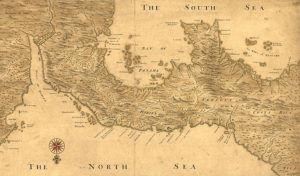
In 1850, Panama City was over crowded due to the thousands who were waiting for a ship to arrive and take them to San Francisco, accommodations were poor and Yellow fever was raging.

When Henry Miller arrived, he found out that the town’s only butcher had fallen ill with the fever.  Henry was never one to miss an opportunity, with the assistance of some of his fellow passengers; he purchased the butchers tools and set up shop to provide meat to the stranded population.  Soon Henry and his partners were making money hand over fist.

In May of 1850, Henry got the fever and he lay in a private hospital until August.

By the time he had recovered enough to visit the shop, his inexperienced partners had ruined the business beyond hope of recovery.  Henry decided to sell out.  When all of the bills had been paid he had scarcely enough for his passage to San Francisco.  He later told people, “If I hadn’t got the fever when I was in Panama, I would have stayed there because the opportunities were very great to make money.”

Edited by Charles Sawyer, Interviews by Ralph Milliken, One Man Show Henry Miller in the San Joaquin, (Los Banos: Ralph Milliken Museum Society, 2003)

Return to Blog list

Comments

Tell us what you think about this blog post.
  • This field is for validation purposes and should be left unchanged.

Under the eves…Volume 1 Issue 2 New York to Panama
  • March 5, 2017/
  • Posted By : Patti Perino/
  • 0 comments /
  • Under :

When we last left Henry…

 He was on his way from New York to San Francisco in 1850; he had to cross the Isthmus of Panama. When he got to Panama City, he was to pick up another ship, which would take him to San Francisco.  However, first he had to cross the Isthmus of Panama.  Henry and some of the men traveling with him hired a man and a pack mule to guide them and transport their possessions to Panama City.  Miller when later discussing the trip stated, “We had a long sack with clothes in it, at night the natives took their mules back home and with them took a great deal of the stuff belonging to the other men.  I took special precaution to watch the mule that carried my goods and I sat up and watched him all night.”

A railroad was built in 1855, but to late to help Henry get to his next port.

When he arrived in Panama City, there was not a ship to be found.  All of the ships had weighed anchor and sailed to California, the crews had heard of the gold strike and where anxious to make their fortunes.  “Gold Fever” had struck again.

Edited by Charles Sawyer, Interviews by Ralph Milliken, One Man Show Henry Miller in the San Joaquin, (Los Banos: Ralph Milliken Museum Society, 2003)

Return to Blog list

Comments

Tell us what you think about this blog post.

  • This field is for validation purposes and should be left unchanged.

Under the eves…Volume 1 Issue 1 How Heinrich Kreiser became Henry Miller
  • February 19, 2017/
  • Posted By : Patti Perino/
  • 0 comments /
  • Under :
Hi…

My name is Patti Perino and I am the new Chairman of the Special Events and Promotions Committee for The Miller Red Barn Association.  I am looking forward to providing you with information about the history of the Red Barn, and about Henry Miller our own Cattle Baron. I will include what is currently happening to save the barn and ways that you can be a vital part in turning The Red Barn into a place that honors all of the diverse people who made Gilroy and Santa Clara County an agricultural power house.

Growing up in the Bay Area during the 60’s, my favorite part of a Saturday Afternoon was listening to a radio show on KGO.  I can’t remember the exact name of the program but it told wonderful tales about the people in San Francisco’s colorful past.  That is my vision for this monthly newsletter.

A little history…

In the late 1800’s until his death in 1916, Gilroy was home to the largest landowner and cattle baron of his time.  In 1891 Henry Miller built a barn on the property now known as the Ranch Side of Christmas Hill Park.  Its purpose was for local hay storage for his cattle and horses then in later years for processing stone fruit grown on Miller’s property.  The Miller Red Barn is Gilroy’s link to the California’s cattle industry and its rich agriculture history.

Thru the dedicated hard work of The Miller Red Barn Association committee volunteers in 2016, the barn received designation as a State Historical Land Mark and also became a Federal Historical Land Mark.  Now we need to make it a thriving part of the community again.

Heinrich Kreiser to Henry Miller…

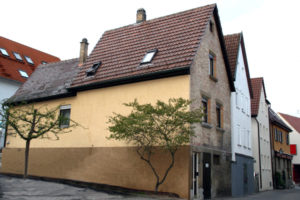
Henry Miller as he is known today started life on July 21, 1827 as Heinrich (Henry) Kreiser in the small German town of Brackenheim in the province of Württemberg.  His father Christian was from a long line of stock raisers and a master butcher.  His mother Christine was from a family of vintners.  He had three sisters.

At 5 he was watching over calves and sheep grazing in the pasture, by the age of 8 he was trusted with the responsibility of chasing after his fathers calves on the roads around Brackenheim on the way to and from the pasture and had entered into a seven year apprenticeship at his fathers butcher shop.  To Henry it seemed that years of being his fathers apprentice would never end.  By the time Henry was 12 he was making purchases of a likely calf or goat and driving it back to his fathers shop.

Henry did attend school from the age of 7 through 14 and that was his only formal education.  He had a singular aptitude for figures and an excellent memory.  He was always ready with answers to any questions put to him by his teachers or minister.

In 1842, when Henry was 14, his mother passed away and his grandmother and sisters took over running the household.  This did not sit well with Henry as he often fought with his sisters. (Not much has changed.)  Henry was restless and chafed under parental control as well as the sever labor load his father exacted from him.

It has been told that the reason he left home was his father’s insistence that he herd a flock of geese. (Sounds kind of like trying to herd cats.)  Henry was so infuriated and humiliated that he came home and told his sisters that he was through and was leaving home.  From Germany he went to Holland and then to England both times working as a butcher.  In 1847 at the age of 19 he sailed from England to New York.  He arrived with a bundle of clothes and $50 American dollars.

While in New York he met a girl he had known in Brackenheim who said that she would help him with his English. He also met a young American man by the name of Henry Miller.  This Henry Miller was a shoe salesman and about the same age as Henry Kreiser the butcher.  Henry the butcher would often invite Henry the shoe salesman for beer and pretzels and practice his English on him.

The hot topic of the day was the California Gold Rush.  Soon they were gripped with “gold fever” and made endless plans to go to California and become rich.  Henry the shoe salesman was able to save for his passage and soon purchased his ticket from New York to San Francisco via Panama.  Henry the butcher saved but he could scarcely save much from his meager wages.

(It is at this point that the story varies depending on who was telling it.)  One version has it that Henry the shoe salesman changed his mind and offered to sell Henry the butcher his non refundable ticket.  It has also been written that Henry the shoe salesman missed the boat and tried to sell Henry the butcher his ticket. Whatever the truth of the matter, it is clear that Henry the butcher bought the ticket, quit his job drew his wages, gathered his belongings and headed for the docks.

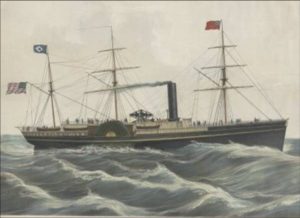
When it came time for Henry the butcher to board the ship he looked at the ticket and saw that it was in the name of “Henry Miller” and the words “Not Transferrable”.  He was afraid that if he told the authorities that he was not Henry Miller that they would not let him use the ticket.  On the spot he made up his mind to go as “Henry Miller” and so he remained the rest of his life.  He sailed for California on April 13, 1850 on the steamer Georgia.

Edited by Charles Sawyer, Interviews by Ralph Milliken, One Man Show Henry Miller in the San Joaquin, (Los Banos: Ralph Milliken Museum Society, 2003)

Return to Blog list

Comments

Tell us what you think about this blog post.

  • This field is for validation purposes and should be left unchanged.

12
Archives
Latest Blogs
  • Under the eaves… Volume 5 Issue 5
    December 1, 2021
  • Under the eaves… Volume 5 Issue 4
    October 4, 2021
  • Under the eaves… Volume 5 Issue 3
    October 4, 2021 , Henry Miller
  • Addendum to Under the eaves…Volume 5 Issue 2
    October 4, 2021
  • Under the eaves… Volume 5 Issue 2
    June 22, 2021
  • Under the eaves… Volume 5 Issue 1
    May 17, 2021
  • Under the eaves… Volume 4 Issue 2
    June 2, 2020 , Henry Miller, San Francisco
  • Under the eaves… Volume 4 Issue 1
    February 7, 2020
CONTACT

The Miller Red Barn Association
777 First Street, PMB-159
Gilroy, CA 95020
millerredbarn@outlook.com

CONNECT

  • Home
  • Shop
  • About
  • Contact
  • Donate
  • Privacy Policy
  • Terms and Services
  • GGC 2024 Plant Sale
We use cookies on our website to give you the most relevant experience by remembering your preferences and repeat visits. By clicking “Accept All”, you consent to the use of ALL the cookies. However, you may visit "Cookie Settings" to provide a controlled consent.
Cookie SettingsAccept All
Manage consent

Privacy Overview

This website uses cookies to improve your experience while you navigate through the website. Out of these, the cookies that are categorized as necessary are stored on your browser as they are essential for the working of basic functionalities of the website. We also use third-party cookies that help us analyze and understand how you use this website. These cookies will be stored in your browser only with your consent. You also have the option to opt-out of these cookies. But opting out of some of these cookies may affect your browsing experience.
Necessary
Always Enabled
Necessary cookies are absolutely essential for the website to function properly. These cookies ensure basic functionalities and security features of the website, anonymously.
CookieDurationDescription
cookielawinfo-checkbox-analytics11 monthsThis cookie is set by GDPR Cookie Consent plugin. The cookie is used to store the user consent for the cookies in the category "Analytics".
cookielawinfo-checkbox-functional11 monthsThe cookie is set by GDPR cookie consent to record the user consent for the cookies in the category "Functional".
cookielawinfo-checkbox-necessary11 monthsThis cookie is set by GDPR Cookie Consent plugin. The cookies is used to store the user consent for the cookies in the category "Necessary".
cookielawinfo-checkbox-others11 monthsThis cookie is set by GDPR Cookie Consent plugin. The cookie is used to store the user consent for the cookies in the category "Other.
cookielawinfo-checkbox-performance11 monthsThis cookie is set by GDPR Cookie Consent plugin. The cookie is used to store the user consent for the cookies in the category "Performance".
viewed_cookie_policy11 monthsThe cookie is set by the GDPR Cookie Consent plugin and is used to store whether or not user has consented to the use of cookies. It does not store any personal data.
Functional
Functional cookies help to perform certain functionalities like sharing the content of the website on social media platforms, collect feedbacks, and other third-party features.
Performance
Performance cookies are used to understand and analyze the key performance indexes of the website which helps in delivering a better user experience for the visitors.
Analytics
Analytical cookies are used to understand how visitors interact with the website. These cookies help provide information on metrics the number of visitors, bounce rate, traffic source, etc.
Advertisement
Advertisement cookies are used to provide visitors with relevant ads and marketing campaigns. These cookies track visitors across websites and collect information to provide customized ads.
Others
Other uncategorized cookies are those that are being analyzed and have not been classified into a category as yet.
SAVE & ACCEPT